
Right now, it feels like every new SaaS product hitting the market is just a thin wrapper around an OpenAI or Anthropic API key. The barrier to entry has never been lower, which means the noise has never been louder. Slapping a sleek UI onto a Large Language Model (LLM) might get you a working prototype in a weekend, but building a sustainable, defensible business around it is a completely different story.
While the hype cycle pushes founders to integrate generative AI into everything, here is why I flat-out refuse to build SaaS products where a third-party AI API key is the core value proposition.
You're Building on Someone Else's Foundation
When your entire product is just a prompt interface for an external LLM, you have absolutely no defensible moat. You aren't building a proprietary technology; you are renting a brain from Big Tech.
The velocity of companies like OpenAI, Anthropic, and Google is staggering. They are shipping updates, expanding context windows, and releasing native features at a pace that indie hackers and small startups simply cannot match. If your SaaS exists solely to summarize documents, generate marketing copy, or chat with PDFs, you are just one platform update away from obsolescence. Big tech can—and will—replicate, deprecate, or absorb your product's entire feature set overnight. You are building your castle on rented land, and the landlord can evict you at any time.
The Business Risk is Real Before You Even Have Users
Traditional software unit economics make sense: you pay a relatively fixed cost for servers, and as you scale, your margins improve. AI API wrappers flip this model upside down in the worst way possible.
With API-based AI SaaS, you are paying per token. Every single time a user interacts with your core feature, you bleed cash. Before you even have the chance to validate product-market fit or figure out if users actually want your SaaS, your costs are scaling linearly with usage. I prefer to spend as little as possible before reaching scale. Tying my baseline operational costs to a variable, unpredictable third-party meter from day one is a massive, unnecessary business risk.
A Security Surface You Don't Control
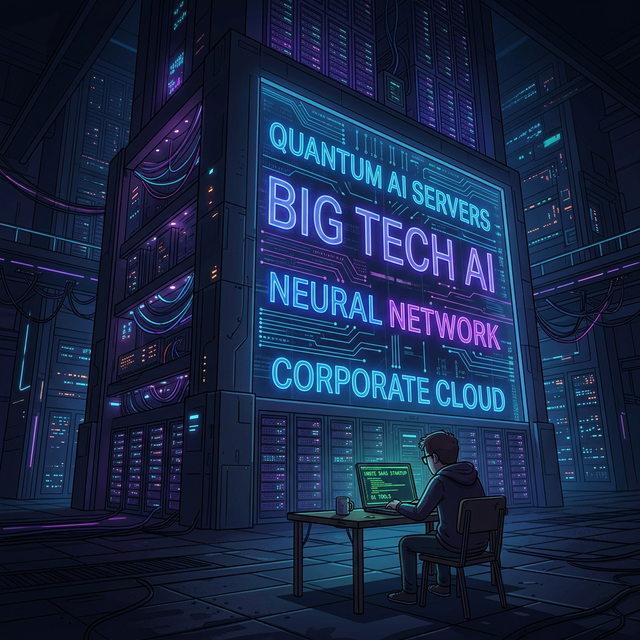 A massive corporate server vault towering over a small indie developer's laptop, symbolizing the risk of relying on Big Tech AI providers
Managing an application that relies heavily on AI API keys introduces a host of security nightmares. Exposing your core product to the public means you are constantly battling rate-limit abuse, malicious actors, and prompt injection attacks.
If someone figures out how to jailbreak your prompt or spam your endpoints, they aren't just breaking your app—they are running up your API bill. You are held entirely responsible for the financial and reputational fallout, yet you have to rely entirely on a third party's security posture to actually patch the underlying model. Handing over control of your application's fundamental logic and security to an external API is a liability I am not willing to accept.
What I Do Instead
This doesn't mean I ignore AI entirely; it just means I treat it appropriately. Instead of wrapping an API and praying for a business, I take a different approach:
- Validate the core problem first: Build lean. Create software that solves a painful, real-world problem using traditional logic, databases, and code. If the product cannot survive without an LLM, it probably isn't a strong business to begin with.
- Treat AI as a feature, not the product: Once the core software has users, traction, and predictable revenue, you can carefully layer AI in to enhance the user experience—not to replace the core functionality.
- Leverage open-source and local models: When AI is genuinely required to solve a problem, I look toward open-source models that can be self-hosted. Controlling the infrastructure means controlling the costs, the data privacy, and the execution.
If your product can be destroyed by a single API pricing change or a new ChatGPT feature, you haven't built a business. You've built a vulnerability.